This past Wednesday evening, I was in the audience for a conversation between author 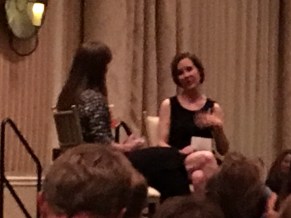 Ann Patchett and Dr. Lucy Kalanithi. Lucy’s husband, Dr. Paul Kalanithi wrote When Breath Becomes Air at age 37, the last year of his life; the book was published in January 2016. I was invited to the event by Patrick’s colleague Peter who wrote in his invitation, “I read the book (When Breath Becomes Air) and it so reminded me of both the beauty and sadness of Patrick’s journey.” With those words, I knew I had to, one, attend the event, and two, read the book.
When Breath Becomes Air is Paul Kalanithi’s memoir and account of his battle with terminal lung cancer. He was a neurosurgery resident at Stanford and 36 at the time of his diagnosis. Dr. Kalanithi’s reflections on his work as a neurosurgeon offer and extraordinary window into the life and caliber of doctors that treated Patrick. But more powerfully, how he faced his diagnosis mirrored so many of Patrick’s (and our) struggles with a terminal illness at a young age. Neither of these men feared dying, and they approached their living with a terrible cancer similarly. Dr. Kalanithi wrote, “I would have to learn to live in a different way, seeing death as an imposing itinerant visitor but knowing that even if I’m dying, until I actually die, I am still living.” Patrick, determined to live each day of his life, would greet the morning with joy, hope, and a sense of purpose.
Dr. Kalanithi wrote, “Because the brain mediates our experience of the world, any neurosurgical problem forces a patient and family, ideally with a doctor as a guide, to answer this question: What makes life meaningful enough to go on living?” Throughout his book, Dr. Kalanithi probes both neuroscience and literature for that answer. Patrick spent much of his own professional career trying to understand and share with others what makes a meaningful life, and having brain cancer distilled that purpose into his day to day existence. Perhaps Paul and Patrick are now contemplating this existential question together; perhaps, now, they don’t have to. They might also share their passion for the written word and how they bathed their infant daughters in that love: Patrick read passages of Anna Karenina to CR; “Paul would hold Cady in his writing chair, reading aloud works by Robert Frost, T.S. Eliot, Whittenstein.”

Throughout Wednesday’s event, Lucy spoke in terms that resonated with my experience: a young widowed mother grieving. Lucy and Ann talked about how being in the presence of someone dying forever changes one’s perspective on living. Ann put words to a phenomenon that I experienced with Patrick during his final months: Being in the room with him, I entered “a light that [I stayed] in, and that clarity [was] gorgeous.” Our priorities were clear: one another; our daughter; our families; time together.
Ann continued, “That light and clarity linger, and it is jarring to be in the noise of people not living in that light, crushing to hear the babble of idiocy of normal life.” I had that sense in those final months and shortly after Patrick died. I would go out on errands and overhear the banal frustrations of people in public areas (railing at crowds, traffic, petty slights, or irate at not being able to remove the wrapper from a tuna sandwich). I would roll my eyes to hear people so upset by the trivial, and I would have to stop myself from yelling, “Do you have any idea how stupid you sound!? Do you have any concept of the REAL suffering in MY life, in countless lives worldwide!? Shut up! Get a grip!” But in entering the public sphere with my own silent pain, I also became more aware and sensitive to the fact that every person is walking around with an unknown, unspoken burden; I tried to interact with each stranger I encountered accordingly, recognizing that a small kindness could make just the needed difference.
A phrase was quoted during Ann and Lucy’s conversation, and I only captured its essence: These moments of grief and pain that we bereaved endure are “the wages of mortal love.”
I will close with a quote from one of Patrick’s favorite authors, Wendell Berry, from his novel Jaber Crow: “I don’t believe that grief passes away. It has its time and place forever. More time is added to it; it becomes a story within a story. But grief and griever alike endure.”
MARATHON UPDATE:
I am running again! I have gotten up to regular 5k runs, which is an improvement from last month. I still have hamstring discomfort, but the longer I run, the looser and more comfortable my stride becomes. Weekly physical therapy appointments will continue in the near term. Summer has been hot, even in the high country, but I have enjoyed the time outside.
I am running the New York Marathon for Patrick and to raise money for B*CURED, a wonderful organization funding brain cancer research. Please support the cause!
 Like the Country