Widowhood Effect

IMG_8252.JPG

We are quickly approaching a year since Patrick died. In many ways, this past month has been one of the hardest. With the marathon and the holidays behind me, I have felt unmoored, and as much as I’d like to keep drifting and linger in the open ocean, CR and my job keep me bumping against the shore of unrelenting responsibilities. In the final weeks of Patrick’s life, we had so much help — bodies bringing food, cleaning, helping nurse Patrick, and visitors — that I longed to just get my house and my own routine back. After the funeral, everyone left, and I had about two weeks of days alone at home, but that was consumed by all of the paperwork that accompanies death.

With just CR and me in the house in the intervening months, I’ve realized that I never got back into a “normal” routine. My ability to plan ahead in my personal life has been crippled, and I have spent much of my time at home reacting to things in front of me — piles of laundry, dirty dishes, meals, toys underfoot, dust, mail, bills, baths — in haphazard flurries followed by ignoring them completely. In the time Patrick’s been gone, I haven’t had a time to turn inward, to grieve alone, to drift and come to terms with an underlying depression that I feel just under the surface. I need a break from reality in a way that, as mother to a four-year-old, I will never get. So, I’m feeling stuck and tired and anxious. The constant torrent of troubling national news hasn’t helped much, either.

Earlier this month, I read an article about the “Widowhood Effect” by Canadian writer Christina Frangou, who was also widowed in her 30s. Perhaps some of what I’m experiencing is related to what she describes: “No one warned me about the cognitive impairment that comes with grief. Tears, heartache, depression – these are expected, but the sustained diminishment of my thinking skills astonishes me.” As I read, I compared my experience to her own. She and her husband were unable to have children, and while I agreed with much of what she wrote, I found myself bristling and wanting to shout at her, “This whole experience is so much harder when you have a young child who needs you to be okay and stable!”

For the most part, I HAVE been okay and stable. CR and I have a lot of fun together, and I am amazed by her joy and enthusiasm. She and I have been able to cry together, too. But her very existence has prevented me from a deep, dark sulk, which, in ways, I still feel I need.

A walk outside in the sunshine would probably help, too.

Power of Powder

“It occurred to him now that people are defined much more by their association with death than by what they do in life. Poor thing, she’s a widow, they say. She lost her mother when she was ten to cancer. I’ve been immune to all this, he thought.”

I am currently reading An Association of Small Bombs by Karan Mahajan, and this passage, spoken by a father whose sons have recently died, rang true. 

As I was getting to know Patrick, the loss of his brother to cancer when Patrick was in high school was one of his defining characteristics. Losing my dad to a lung disease when I was only 27 set me apart from many of my peers. Like Patrick’s brother, my father had struggled with a progressive disease and failing health for many years, and Patrick and I connected in having lived in households cocooned by debilitating illness. Now as a young widow, I know that my closeness to Patrick’s death influences how people interact with me. With people I have just met, the death of my husband is the first thing on my mind when I’m filling in the basic “getting to know you” information. I find myself making an assessment of how much to divulge: “Do I want to get into that part of my story if I will never see this person again?” I prepare myself for the arresting effect it will have and the extra effort it requires to receive the awkward expression of a stranger’s sympathy. A few times, I have introduced myself to someone who knew Patrick but not me, and I have seen the light of recognition in their eyes: “Oh! This is his widow.” I am still not used to that term, widow, and it is in the reactions of strangers that I see it mirrored most starkly.

This past month has been a tough one. The darkness of winter, aching post-marathon joints, the national discourse, and preparing for the holidays in the absence of Patrick have left me feeling anxious, fatigued, and deeply sad. I can never seem to keep on top of the endless house chores, meal preparation, and the finding of misplaced but essential items that accompany child-rearing. This past Saturday, I had planned to drop CR off at her ski lesson and return home to clean, wrap presents, and have some time to myself. Fortunately, I was reprieved from all of that by an overnight snowfall of 19 inches!

1929954_533000745073_2546_n

I scrapped the housekeeping in favor of skiing, and I’m so glad I did; I think it saved me! Saturday was a day that reminded me why I love skiing. The glorious sensation of floating through two feet of soft snow reverts serious, responsible adults to giddy, whooping kids. I skied with parents of kids in CR’s daycare program, none of whom I know beyond the pick-up and drop-off pleasantries. We had so much fun, reveled in the kinship of a shared adventure, and parted with hugs at the end of the day. When I went to meet CR in the late afternoon, her instructor informed me that she had made a huge leap and was turning and stopping on her own. CR was keen to take another run, and watching her ski in front of me, I felt as the Grinch must have when his heart trebled in size. I was the happiest I have been in a long time sharing that one ski run with my daughter. She, too, will be marked and defined by her father’s death, but CR can now add “skier” to her list of attributes.

Here’s to the redeeming power of powder and to many more ski days with CR.

https://www.instagram.com/p/BOIyvjFBXUR/?taken-by=alpenglow80&hl=en


As I was getting ready to post this, I learned that the driver of a truck took the lives of at least nine people and injured many more at the Christmas market in Berlin. When I hear of the sudden, violent deaths happening daily around the world, I am reminded how tenuous human life truly is. We – those of us in a warm place with a computer (of all things!) – are blessed in so many ways, and I grieve with those who have lost loved ones today.

The Sports Tour

Patrick had a dream of doing a great European sports tour in July that included Wimbledon, the British Open, and the Tour de France. He was a sports fan in the purest sense. While he did have loyalties to teams, the NE Patriots in particular, he watched sports not so much for the entertainment value, but more because he marveled at human physical capacity and appreciated true athleticism. He would cheer for any member of the opposing team when he or she completed an amazing feat.

Enjoying professional sports inspired Patrick to get out and play, a trait he inherited from his father, Jim. Jim would read Bud Collins’s tennis column out loud over breakfast, then strap on his Jack Purcells and head to the courts with Patrick, or whoever else would join him. In the summer after Patrick’s diagnosis, we got together with family over Labor Day Weekend. Though tired from chemo and out of practice with a club, he went golfing with his cousin and brothers-in-law (The Outlaws). He was so glad for the time with the men he admired. Jim, having passed away the year before, was with them in spirit, and though I don’t know this for certain, I would bet that they retold Jim’s many great golfing stories as they walked between holes. 

Untitled design

Pinehills Golf Club, August 2014

Patrick was affronted by the rash of doping scandals across all sports because he felt that it called into question any achievement. Instead of applauding a record being broken or other personal accomplishment, he felt that people were becoming immediately skeptical and suspected cheating to be uncovered. It was his sincerest wish that Lance Armstrong be innocent of charges, and Patrick, like many, was disappointed when the extensive doping by him and his team was substantiated .

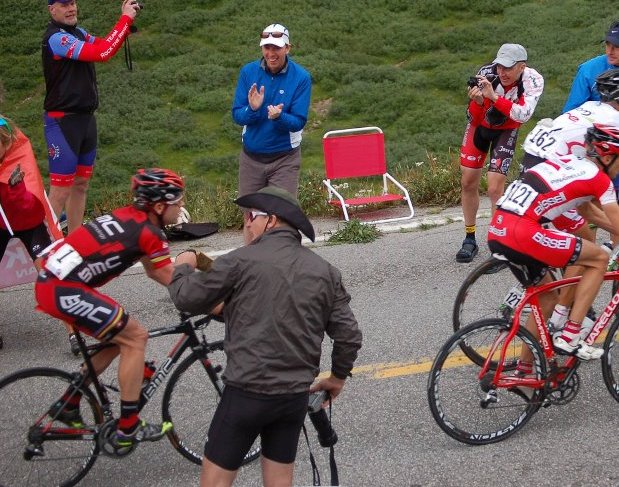
He continued to love the sport of cycling, however, and he rode up our mountain passes with Phil Liggett and Paul Sherwen in his head, narrating his ascent as though he were riding up Col du Tourmalet or Alpe d’Huez: “They have hit this climb so fast I thought they were going to sail off into space!”; “He is riding like a man possessed!”; “He really is a man on a mission today!” I know this because when we would ride together, Patrick would sometimes shout out something akin to these lines (British accent and all) just before jumping out of his saddle and attacking a climb ahead of him.

299953_900252230153_1017687_n

Cheering Cadel Evans up Independence Pass, US Pro Cycling Challenge 2011

In Patrick’s memory, I have been following Wimbledon and the Tour this month, and I’ll tune-in to the British Open this weekend. Perhaps when CR is older, we’ll go on that European sports tour and talk about how much her dad would have loved to be there, cheering the indomitable human spirit to victory.

Allez! Allez! Allez!

Thank You, E.B. White

EB and Charlotte

In the months before Patrick died, CR and I started listening to Charlotte’s Web, read by the author, during the car rides to and from my work/her daycare.

CR was immediately drawn into the storyline of Fern and Wilbur. Her pink, plush, toy pig immediately was renamed for the protagonist. She cheered when Wilbur escaped from his pen and empathized with his loneliness in the barn before Charlotte greets him with her famous, “Salutations.” E.B. White’s matter-of-fact narration and New England accent add depth to the story and humor that I may have missed without his inflection and emphasis. CR and I have now probably listened to the story, start-to-finish, five times.

As the story closes, Charlotte dies. My gratitude to E.B. White is for presenting death in real terms, with real emotion, in language that children, that CR, can understand. With Patrick’s diagnosis, I began questioning all of the social workers and doctors we met on how to talk to CR about death so that she might process losing her father in a healthy way. While I got wonderful tips about how to talk with her, it was while listening to Charlotte’s Web that started our real, ongoing conversation about what death is and how it affects a family. For CR, it was clear how much Wilbur missed his friend, and that even though she was gone, he was still connected to Charlotte through his memory of her and through her children.

I feel confident that CR feels closely connected to her father, even with him absent. Thank you E.B. White for helping us start a conversation that will keep Patrick present in our lives and for helping CR begin a lifelong process of healthy grieving.


Marathon Training Update

My physical therapist has advised that I still not run. As the weeks tick by, I am growing restless and more concerned about my training plan’s interruption. I have another appointment in early June. I’ll keep you posted.

Keep the Bright Memories

In quiet moments in the past months, I have found myself dwelling on the difficulties of Patrick’s rapid decline. I saw the suffering and burden he bore by first not being able to use his right hand, next walking with difficulty, and finally not being able to support weight on his right side at all. The traumas of his last days sometimes crowd out the happy memories of years together. I have to deliberately shift my mental focus to the multitude of joys we shared, but often the stress and sadness of his final days seep back to the fore.

12633554_10102100890151093_5887978298985833659_o

Mother/Daughter adventure boots. January 2016

I am thankful for the slide show of photos that play nightly on a digital frame in our kitchen. The images recall the joy and the adventures of our lives: Pictures from before we met; our first summer together; our first apartment; friends; trips; and hundreds of CR. In the background, though, the echo of Patrick’s death reverberates loudly in our home and in our thoughts. Day-to-day, however, we are happy, and my daughter and I will continue to enjoy and capture moments that will one day rotate in our slide show.

CR picked up a rock at her preschool yesterday, black and river polished, and as she held it out to me she said, “This is my Daddy Phone. He called me from Heaven and said he would come to see me. I can call him and talk to him whenever I want.” Moments and conversations like these have been frequent with CR the past few months. I know that she was aware of his illness and of his increasing debilitation (she notices and comments on people with slings or canes“Just like Daddy,” she’ll say). Her memories of her father are happy and, for her, normal.

Adjusting to life as a widowed parent has been a separate challenge; more often than not we are late getting out of the house in the morning, and I end up late for work. CR and I recently traveled to attend the funeral of my aunt, who also had lost her battle to cancer. There were moments of cajoling and carrying my daughter so we could stay together in airport terminals. She had an accident on the plane, and I didn’t have a change of clothes for her, so she deplaned wearing my sweatshirt as a skirt, which she had to keep hitching up as we made our way to baggage claim. Managing her and our bags was both comical and harrying. I was initially concerned that CR would not react well to attending another funeral so soon after her father’s, but we approached it as a celebration of my aunt’s life, and framed it for her as a party where we got to see our family. Again, she amazed me with her resilience and joy.

My uncle, too, will most likely suffer from the trauma of witnessing a difficult death. I hope for him that he is able to keep the bright memories of his wife’s life at the ready.


MARATHON UPDATE:

The marathon training has insisted that I pay attention to my body. A lingering ache in my right hamstring led me seek-out a physical therapist, and my weekly appointments bring Patrick to mind. Patrick never resigned himself to his diagnosis or to the physical manifestations of his tumor. At every turn, he looked for help to maintain and strengthen what he could for as long as he could. I gained a deep respect for the work his physical and occupational therapists did with Patrick, and I’m glad to be working with a physical therapist on my own body. I have given up two weeks of running already to build strength and gain flexibility in my legs, which pales in comparison to Patrick’s efforts to be well. I am frustrated by my own set-back, and yet, it is a reminder of why I signed on for a marathon in the first place — to honor Patrick’s struggle with cancer.

Language of Loss

I am currently at a professional conference. My daughter, who is three, is with my mom at our home. This is the first time I’ve been away from her for more than the workday since Patrick died. I got a FaceTime call last night from CR, and she was gasping sobs, wanting me to be there as she went to sleep. I sang her some songs– ours are “Twinkle Twinkle” and “Over the Rainbow” — and my mom reported that she went to sleep pretty easily after we had said goodnight.

img_0518The opening speaker at the conference was CNN’s Anderson Cooper, who was promoting his new book about his relationship with his mother, Gloria Vanderbilt. Cooper lost his father when he was only ten years old and lost his brother to suicide when he was a senior in college. He said two things during his talk that I found haunting:

  1. Regarding the death of his father, he said he realized that “all things are possible and nothing is safe.” CR is much younger to have suffered our loss, but I think her tears last night may have been rooted in a fear that, like her father, there is a possibility that I might not come back.
  2. After his brother’s suicide, Cooper sought out war zones to report on because, as he put it, “I wanted to be around people who spoke the language of loss.” CR and I talk about her father on a daily basis, and she usually initiates the conversation. This is our shared experience. My three-year-old and I speak a language of loss that none of our peers have yet learned; Her friends all still have daddies; My friends are either recently married or still single. In my family, I am the first faced with raising a child without a spouse.

Tonight’s bedtime phone call was much better–no heart wrenching sobs–but the anxiousness in CR’s voice about my absence is evidence of this new language she’s been forced to learn. Does the death of someone you love make you instantly fluent in the language of loss, or like all new languages, does it take years to learn?

P.S. The running continues. I am sore, and the soft skin of my feet is tender, but as I alternated walking and running in the crisp air of early morning, I felt hopeful and happy and glad of the effort.

P.P.S. I promise I wrote my blog’s tag line BEFORE I saw Cooper’s book cover!